Hindus threatened and intimidated for their faith, Bangladeshi Muslims demand they "go back to India" if they want to worship Lord Ram
 Gaibandha District, Bangladesh
  9 June, 2026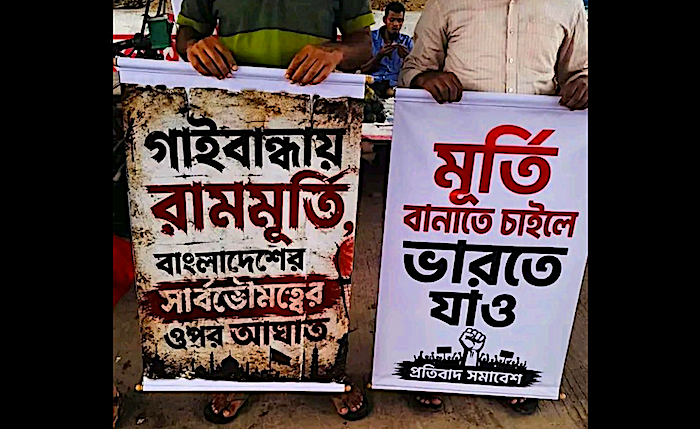
Case Summary
The campaign against the construction of a Ram idol in Bangladesh's Gaibandha district escalated further when groups of Muslims took to the streets carrying posters that warned Hindus to "go back to India" if they wished to build the idol. The demonstrations marked a significant intensification of the hostility already directed at the Hindu religious project for several weeks. A post shared by Voice of BDHindus showed Islamists carrying posters that read "Statue, If you want to make it, go to India". At the centre of the controversy was the under-construction Sanatan Complex, being developed around the historic Sri Sri Radha Govinda Kali Temple in Komorpur village under Hosenpur Union. The project included a large idol of Lord Ram along with other Hindu religious structures. From the outset, the development attracted organised hostility from sections of the local Muslim population and Islamist groups, whose objections were directed specifically at the construction of the Ram idol and the visible expansion of Hindu religious infrastructure in the area. During the public protest, speakers declared that no Ram idol would be allowed to be built in Palashbari and stated that any attempt to proceed with the construction would be resisted. The gathering focused on opposing the Hindu religious project and urging the administration to intervene against it. Speakers repeatedly described the idol as provocative and demanded that government authorities take steps to halt its construction. The protest gathering further targeted the Hindu community's right to establish the religious monument. Speakers stated that if Hindus wished to build idols, 'they should go to India and build them there and that they should not be permitted to construct such idols in Bangladesh'. The statements directly linked opposition to the project with the Hindu religious identity of those involved in its construction and worship. The rhetoric extended beyond opposition to the idol itself. Speakers asserted that the construction of the Ram idol represented a 'conspiracy against Bangladesh' and described the project as an attempt to insult Islam. The proposed height of the idol was deemed unacceptable, and calls were made for the administration to immediately halt construction. Protesters further demanded that the partially completed structure be demolished using bulldozers. The gathering also directed hostility towards Haridas Chandra Tarnidas, who was identified by speakers as being associated with the project. Multiple accusations were levelled against him during the protest, and speakers attempted to portray the Hindu religious project as part of a broader conspiracy involving India. The Ram idol was repeatedly presented as a threat requiring state intervention, administrative action, and demolition. The protest did not emerge in isolation. Prior to this incident, the same Ram idol project had already become the subject of an extensive anti-Hindu campaign conducted both online and offline. Social media platforms carried inflammatory content opposing the construction of the idol, including posts demanding that the project be stopped, portraying Hindu religious activity as unacceptable, and encouraging public hostility towards the temple complex. One campaign included calls to desecrate the idol, while another involved Islamist leaders organising a formal press conference and submitting an eight-point memorandum demanding that the government immediately halt construction of the Ram idol and investigate those associated with the project. The present protest represented a further escalation of that campaign, extending opposition from online agitation and organisational lobbying into direct public mobilisation against the Hindu religious project. The events occurred against the backdrop of escalating hostility towards Hindus in Bangladesh. This escalation of violence against Hindus in Bangladesh has unfolded in three distinct phases: first, following the ouster of Sheikh Hasina's government in August 2024; second, after the death of Sharif Osman Bin Hadi in December 2025; and third, in the immediate aftermath of the 13th National Parliamentary Election 2026. Following the ouster of Sheikh Hasina, multiple reports documented attacks on Hindu homes, temples, and religious institutions, alongside intimidation campaigns, arson, and mob assaults targeting minority neighbourhoods. The Hinduphobia Tracker recorded 336 such incidents against the Hindu minority, underscoring the scale and persistence of anti-Hindu violence during this period. A further escalation occurred following the death of Sharif Osman Bin Hadi, a Muslim political activist and student leader known for his anti-Hindu and anti-India rhetoric. Hadi had been involved in political unrest after the fall of the Hasina government and was killed in Dhaka on 18th December 2025 during clashes. In the aftermath of his death, Hindu communities were blamed and subsequently targeted in retaliatory violence. Hindu homes were selectively set ablaze in multiple localities, forcing families to flee and leaving many displaced. The attacks appeared patterned rather than sporadic, with Muslim mobs focusing on Hindu neighbourhoods, properties, and religious symbols. Among the victims was Dipu Chandra Das, who was lynched to death and his body was set ablaze by a Muslim mob over false blasphemy allegations. The Hinduphobia Tracker documented 51 incidents of anti-Hindu violence in the period following Hadi's death alone. Such incidents underscored the vulnerability of the Hindu minority amid rising communal hostility and the weaponisation of religious accusations. Reports further indicated that posters and written materials calling for the extermination of Hindus were displayed in public spaces, signalling an alarming normalisation of genocidal rhetoric. When combined with acts of arson, vandalism, assault, and targeted intimidation, these developments suggested a coordinated environment of hostility aimed at terrorising the Hindu community and reinforcing majoritarian dominance. The third phase of violence emerged after the 13th National Parliamentary Election 2026. Within days of the announcement of results, Hindu families in districts such as Noakhali, Rangpur, Nilphamari, Sylhet, Thakurgaon, and Dinajpur reported coordinated attacks involving arson, looting, assault, and vandalism of temples and homes. In several instances, Hindu homes were selectively targeted, looted, and families were threatened with displacement.
Why it is Hate Crime ?
This case has been added to the tracker under the primary category of - Hate speech against Hindus. Within it, the sub-category selected - Anti-Hindu slurs and mocking faith. Anti-Hindu slurs and the deliberate mocking of the Hindu faith owing to religious animosity involve the usage of derogatory terms, stereotypes, or offensive references to religious practices, symbols, or figures. One of the common anti-Hindu slurs used against Hindus is “cow-worshipper” and “cow piss drinker”. The intention of using this term is to demean and mock Hindus as a group and their religious beliefs since Hindus consider the cow holy. Additionally, some symbols and the slurs attached to them have a historical context that exacerbates the insult, hate, stereotyping, dehumanisation and oppression against Hindus. Cow worship has been used for centuries to denigrate Hindus, insult their faith and oppress Hindus specifically as a religious group. There has been overwhelming documentation about how cow slaughter has been used to persecute Hindus with cow meat being thrown in temples and places of worship. There has also been overwhelming documentation where cow meat (beef) has been force-fed to Hindus to either forcefully convert them to Islam or denigrate their faith. Apart from cow worship, the Swastika – which holds deep religious significance for the Hindus – has also been misinterpreted and distorted to use as a slur against Hindus. Similarly, the worship of the Shivling has been used by supremacist ideologies and religions to denigrate Hindus owing to religious animosity. Such slurs and denigration stem out of inherent animosity and hate towards Hindus and their faith, therefore, it is categorised as hate speech targeted at Hindus specifically owing to their religious identity. Another sub-category selected for this case is - Violent threats. Violent threats, explicit, implicit or implied, is the most dangerous form of hate speech since it goes beyond discriminatory and prejudicial language to express the intent of causing harm to an individual or a group of people based on their religious identity and faith. There could be several different kinds of threats that are issued to Hindus based on religious animosity. An explicit threat would mean the direct threat of violence towards an individual Hindu, a group of Hindus or Hindus at large. Physical violence, death threats, threats of destruction of property belonging to Hindus and threats of genocide would mean explicit threats against Hindus for their religious identity. Implicit threats may not be a direct threat but implied through the use of symbols of actions – for example – in the Nupur Sharma case, other than explicit threats, there were also implicit threats when Islamists took to the streets to burn and beat her effigies. It implies that they want to do the same to Nupur Sharma – thereby is considered an implicit threat. Violent threats can be delivered in person, through letters, phone calls, graffiti, or increasingly through social media and other online platforms. It would be important to understand that a threat – explicit or implicit, online or offline – to an individual who happens to be a Hindu does not qualify as a religiously motivated threat. Such a threat, while vile and dangerous, could be owing to non-religious reasons and/or personal animosity. To qualify as a religiously motivated threat, it would need to exhibit an indication that the individual is being targeted for religious reasons and/or owing to his/her religious identity as a Hindu. This case has been included in the tracker because the hostility expressed towards the construction of the Shri Ram idol went beyond disagreement and reflected contempt towards a core aspect of Hindu religious belief. The objection was not directed at unlawful conduct, encroachment, or interference with the rights of another community. Rather, the opposition centred on the very existence of a prominent Hindu religious symbol and the willingness of Hindus to publicly practise and express their faith. By portraying the construction of a Ram idol as something unacceptable and by insisting that Hindus should leave Bangladesh if they wished to build such religious monuments, the rhetoric treated Hindu religious expression as illegitimate within the country. Such messaging conveyed the view that Hindu traditions, beliefs, and forms of worship were less deserving of acceptance and protection than those of the majority community. The prejudice underlying these statements becomes more apparent when considering that idol worship occupies a central place in Hindu religious practice. Bhagwan Shri Ram is one of the most revered deities in Hinduism, and the construction of an idol dedicated to him represents a legitimate act of religious devotion. The hostility directed towards the project, therefore, carried an unmistakable religious dimension because it targeted a sacred Hindu symbol specifically because it was Hindu. The suggestion that Hindus should go to India to build idols effectively mocked and delegitimised their place within Bangladesh's religious landscape. Such rhetoric did not merely reject a structure; it rejected the public manifestation of Hindu faith itself. In doing so, it conveyed contempt towards Hindu religious identity and reinforced the notion that Hindu beliefs were unwelcome in a Muslim-majority society. The case also falls under the category of 'Violent Threats' because the language employed during the campaign carried implicit threats towards Hindus and their continued exercise of religious freedom. While the statements did not always contain direct promises of physical violence, they repeatedly framed Hindu religious activity as something that would not be tolerated and that would face consequences if it continued. The demand that Hindus should build idols in India rather than Bangladesh suggested that Hindus could not fully belong within the country unless they abandoned visible expressions of their faith. Such rhetoric carried an exclusionary message that linked Hindu religious identity with displacement, marginalisation, and removal from public life. The repeated portrayal of the Ram idol as a threat to be suppressed further contributed to an atmosphere of intimidation. By presenting Hindu religious expression as a provocation against the Muslim majority, the campaign encouraged the perception that Hindus who openly practised their faith were acting against the interests of society. This transformed an ordinary act of worship into something portrayed as deserving opposition and punishment. In a context where Hindus constitute a vulnerable religious minority and have faced sustained hostility, language suggesting that Hindu symbols should not exist in Bangladesh inevitably carried coercive implications. The message communicated to Hindus was that the continued assertion of their religious identity could expose them to organised hostility and social consequences. The incident must also be viewed within the wider anti-Hindu environment that has emerged in Bangladesh in recent years. During periods in which Hindu temples, homes, businesses, religious processions, and places of worship have repeatedly come under attack, campaigns that seek to exclude Hindu religious symbols from public life acquire greater significance. The hostility directed towards the Ram idol was not simply criticism of a construction project; it reflected a broader pattern in which Hindu identity itself became the basis for opposition. The fact that the target was a sacred Hindu symbol, and that objections focused on the acceptability of Hindu religious expression in Bangladesh, strongly supports the conclusion that the animosity was rooted in religious prejudice. Viewed in its entirety, the campaign expressed contempt towards Hindu beliefs, questioned the legitimacy of Hindu worship, and conveyed that Hindus should look outside Bangladesh if they wished to freely practise their religion. The combination of faith-based hostility, exclusionary rhetoric, and implicit threats directed at a Hindu religious symbol demonstrates clear anti-Hindu animus and reflects an attempt to discourage the public expression of Hindu identity. Given Bangladesh's sustained anti-Hindu persecution environment, this case meets all thresholds for inclusion in the Hinduphobia Tracker's hate crime database. Disclaimer: Opposition to the Shri Ram idol project in Palashbari had been ongoing through public protests, banners, speeches, and organised mobilisation over an extended period. Available sources documenting banners stating that Hindus should build idols in India rather than Bangladesh do not specify an exact date. Therefore, 10th June 2026, the earliest verifiable source date connected to the organised campaign against the Shri Ram idol project, has been used as the incident date in the Hinduphobia Tracker for documentation purposes only.


Case Status
Unknown


Perpetrators Details
Perpetrators
Muslim Extremists
Perpetrators Range
Unknown
Perpetrators Gender
unknown
 Sources




